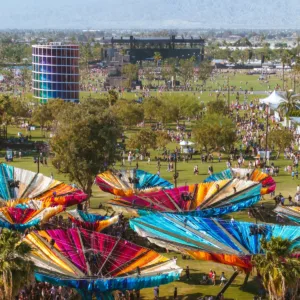
LAGI (Land Art Generator Initiative) is an association founded by Elizabeth Monoian and Robert Ferry in 2008, just after their wedding. Over drinks in Dubai, they asked themselves how artists, designers and engineers could work together to use art as a raw material to create energy technology infrastructures.
In January 2010, when they launched their first call for projects, within 24 hours they received hundreds of proposals from all over the world, bursting with imagination and technical ambition.
The Emirati company Masdar, Zayed University and the Horne Foundation are the first organizations to lend their support to LAGI. Driven by scientific curiosity and civic commitment, thousands of artists, designers, engineers and students from 60 different countries are coming together to take up the challenge of climate art.
“The O”, a multi-purpose infrastructure
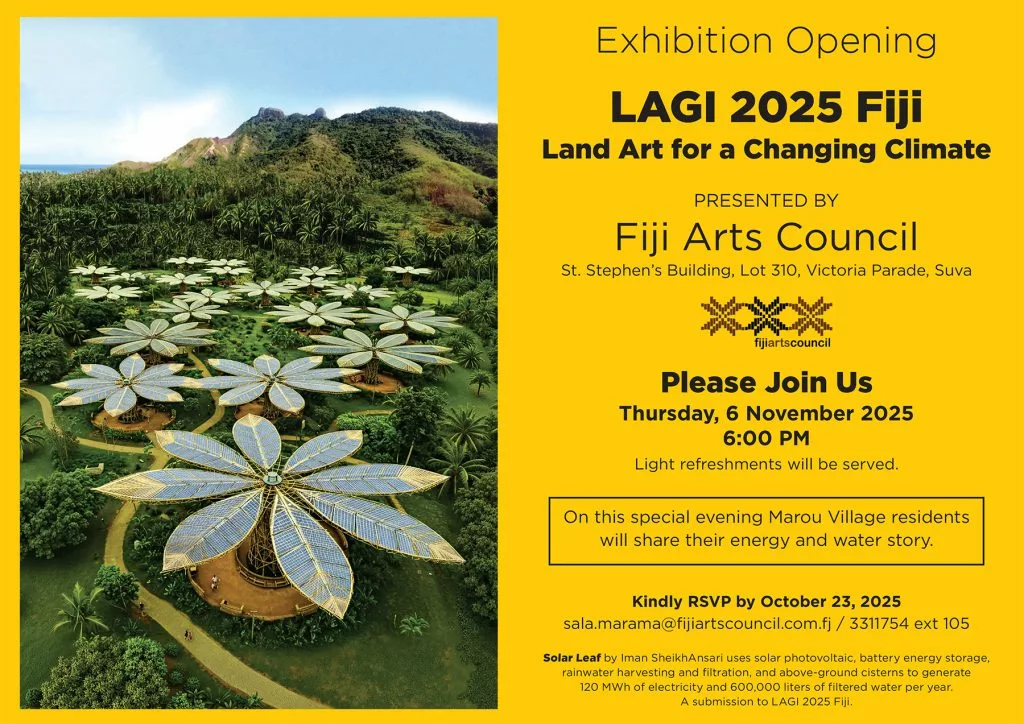
In 2025, LAGI collaborated with the village of Marou, on Fiji’s Yasawa Islands, to create a clean energy future. Alberto Roncelli, an Italian artist based in Denmark, was selected after a call for projects to design a circular pavilion to provide clean energy.
“The O”, a 40-meter-diameter space in the canopy, incorporates photovoltaic panels and supplies energy. It is also a meeting place for the local population. The installation produces 150 MWh of electricity each year, powering the 67 households in the village of Marou. The pillars supporting the pavilion, engraved by artist Sonny (Yanuyanu Art), reproduce the symbols of the village.
LAGI 2025 Fiji was realized in coordination with the Fiji Department of Energy, the Fiji Rural Electrification Fund, UNDP and the Fiji Ministry of Tourism.
Village chief Ilisari Naqau Nasau sees the project as more than just infrastructure. For him, it’s a sign that the village is a place where people can get an education, and also a demonstration that his community and his land are one and the same.
When “the O” lit up for the first time, the community came to bless the project with the Kava, a ceremony of unity, relaxation and spiritual connection typical of the Fiji Islands. The solar batteries produced such powerful energy that the space filled with music. Today, “The O” is a 600 m2 cultural and social space. It includes an artisan market, a community garden and cultural uses. The project fits into the ecosystem of renewable energies, climate change and sustainable tourism.
Photo credits: Alberto Roncelli