The “Pow. r. toc h.” Exhibition at the Donjon de Vez
For Edgar Sarin, this exhibition is both carefully structured and, at the same time, a living entity that evolves almost independently. The works are positioned as if he were seeking to gradually occupy the space. This exhibition is held primarily in the Chapel, a very special place where each space has a distinct function and striking architecture. Edgar Sarin thus presents his works as ways of inhabiting the space: sometimes in a well-organized manner, and sometimes through spontaneous gestures.
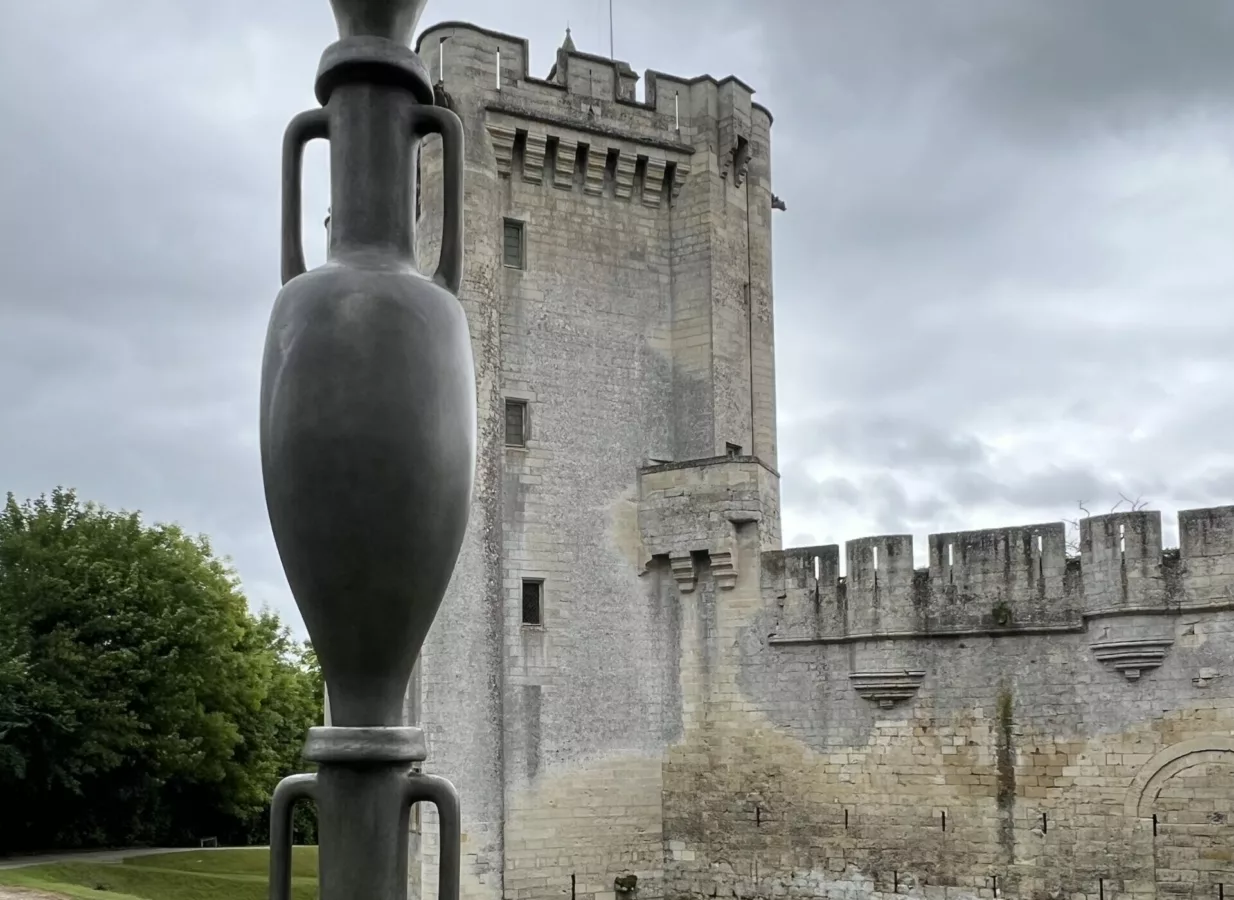
Outside: a frozen sculpture
Outside the city walls, the artist has installed *Bronze aux amphores* (2026). These ancient objects, once used to transport and store goods, serve here as the inspiration for a monumental work. Transformed into bronze—and thus taking on a heavy, permanent appearance—these amphorae are stacked one on top of the other. These objects, once meant to be in motion, become immobile. Their meaning and presence are therefore completely altered, giving the Donjon de Vez a new lease on life.
Balance and Perception in the Buren Room
In this room featuring Daniel Buren’s stained-glass windows, Edgar Sarin presents two paintings: the Hildegard von Bingen series (2026). Drawing inspiration from ancient starry ceilings and the mystical visions of Hildegard von Bingen, he brings a new image to life within the old paintings, thereby revealing a new work within the existing work.
In this room, you can also see *Egyptian Heroine* (2026). This sculpture, based on a work by Maillol, explores balance, the relationship between solid and void, and how perception changes depending on the viewing angle.
The chapel is a place steeped in history, and this exhibition adds many layers of meaning and a whole new perspective.
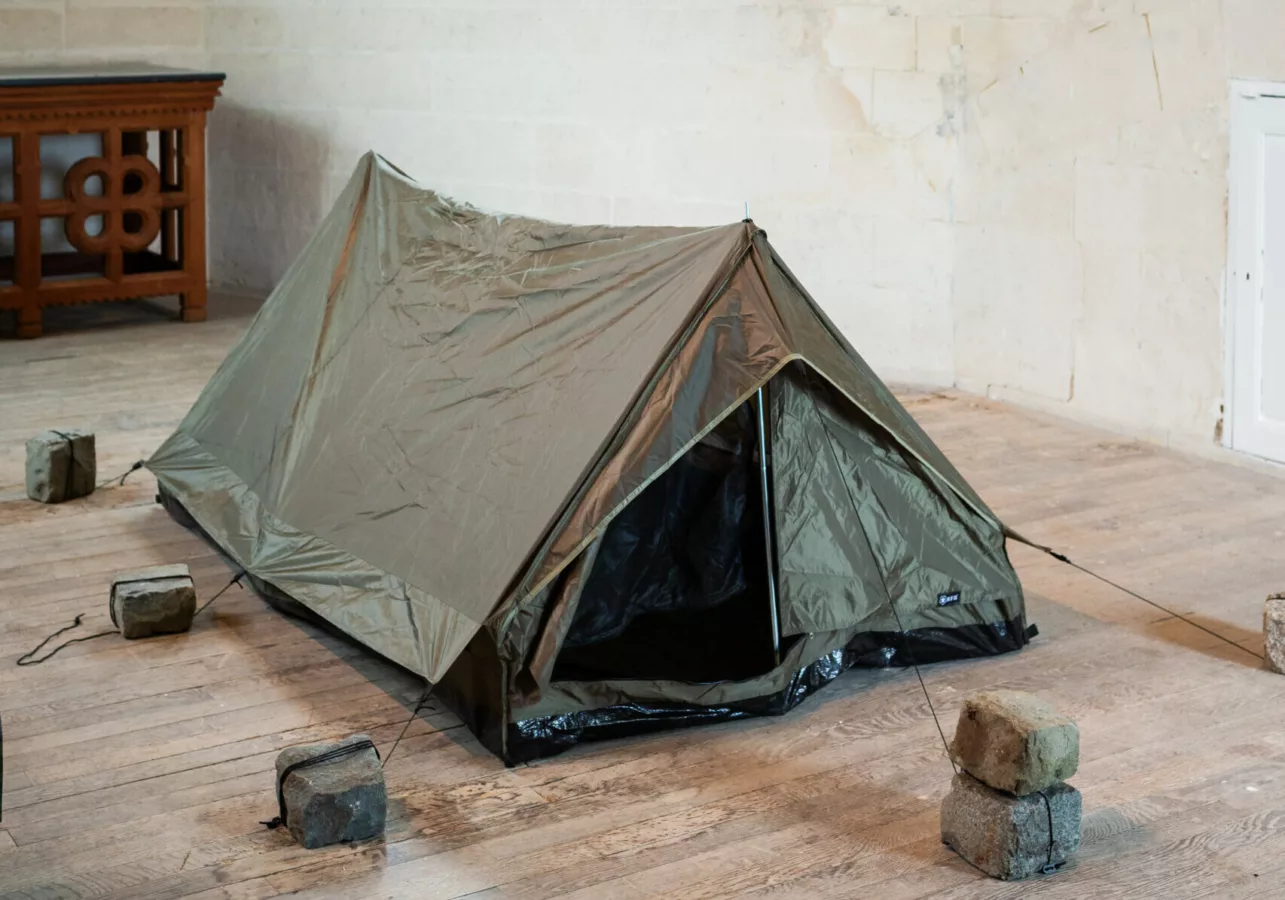
The guardroom serves as a transitional space between the exterior and the interior. It evokes a simple idea expressed by the poet Pierre Albert-Birot: “The world beats on the other side of my door.” In this space, Edgar Sarin has installed *Architecture No. 1 – Flexible Principle* (2026).
The Guard Room: A Space of Transition
Here, he creates a functional structure: a sort of tent, designed to be moved and lived in. This tent, made for a single person, resembles a minimalist shelter—what the philosopher Gaston Bachelard calls “the absolute of refuge.” Surrounding it are wooden objects that suggest a human presence. He also includes a sculpture from the Haniwa series (2023), inspired by Japanese funerary objects placed around graves.
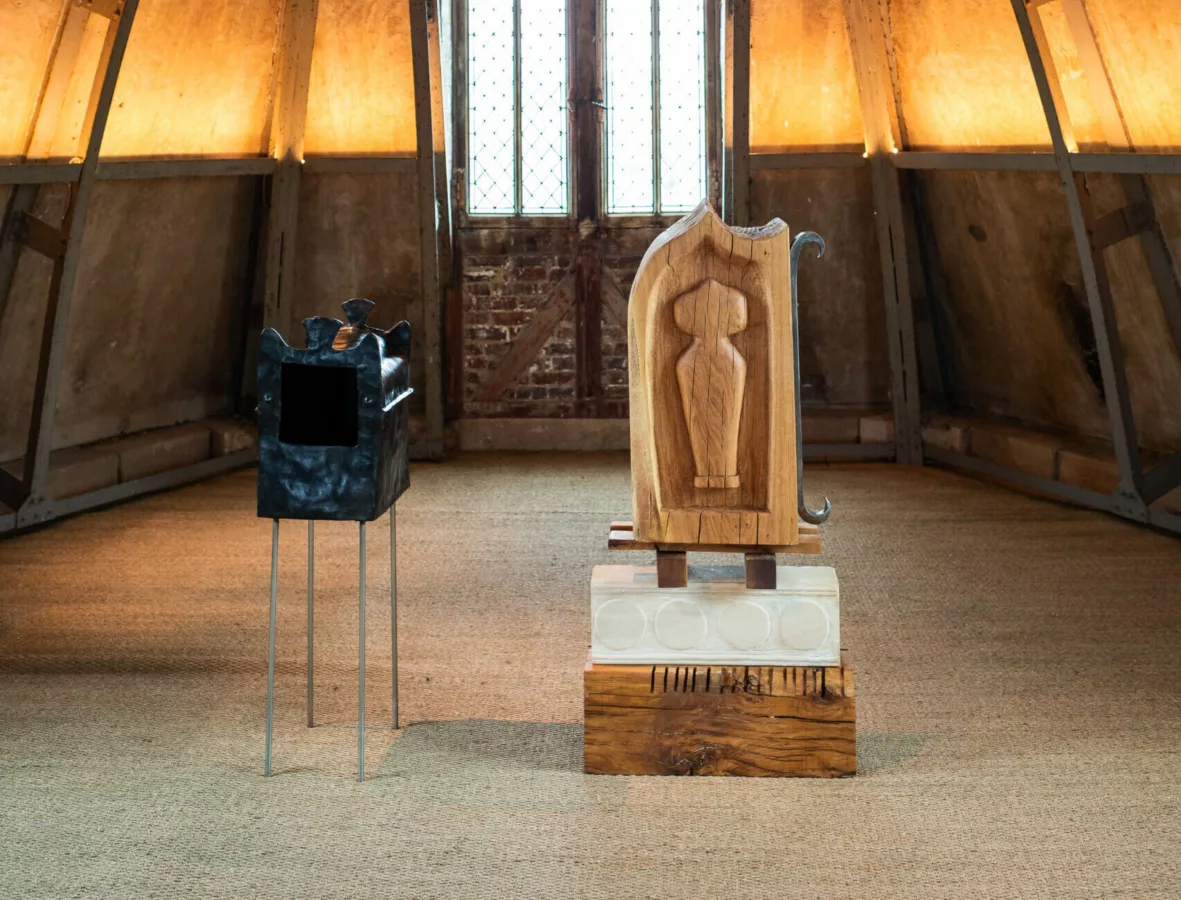
The Eiffel Frame: A Link Between the Mortal and Immortal Worlds
In this attic room, the artist has installed two works: a *Sarcophagus* (2025) and a *New Monument* (2026) inspired by a Gallo-Roman ex-voto. These objects have one thing in common: they serve to bridge the gap between the living and the dead, or between humans and the gods.
A fan creates a breeze in front of these works, making the air visible and giving the impression that something invisible is passing through the space, like a trail left in the sky.
With this simple gesture, Edgar Sarin highlights a very fragile, almost imperceptible moment that the philosopher Vladimir Jankélévitch calls the “almost-nothing”: something invisible that we sense without being able to truly define it.
A Logic Between Rule and Chance
Throughout the exhibition, Edgar Sarin alternates between simple, recurring actions (stacking, digging, engraving) and more unpredictable interventions. This creates a balance between structure and spontaneity. This unique exhibition is not intended to be fully explained but rather to give free rein to visitors’ thoughts. The works exist within the space, and visitors are free to move about, experience them, and gradually become part of the space itself. Through this exhibition, Edgar Sarin transforms this historic site into a living space, where the works explore themes of memory, passage, and presence—a link between past and present. This exhibition runs through November1, 2026.