Tower… this word has many meanings. So let’s take a little tour through the tour de force that Dubuffet achieved with his “Tour aux Figures.”
Art Brut: An Unconventional Art Form
Jean Dubuffet, a French painter, sculptor, and visual artist, is also the founder of “art brut.” Born into the French bourgeoisie and not particularly enthusiastic about his studies, he enrolled at the École des Beaux-Arts in Le Havre. He was a self-taught, original, and rather reclusive figure. He traveled extensively and was convinced that art was undergoing a transformation. He was searching for his own path, experimenting, and rejecting museum art in favor of “the art of the mad”—the art of outcasts, prisoners, mystics, and rebels. He met with psychiatrists and traveled to hospitals in Switzerland and Germany. He had an anti-cultural streak and based his work on childlike scribbles and smudges. Moreover, already well-off financially, he didn’t even try to sell his work.
He constantly renews his means of expression, moving from the desert—the “nothingness” where he created “Marabout,” “Arab,” and “Hobbled Camel”—to a series of “Landscapes.” He then produced a series of portraits, followed by small statues. Beginning in the 1950s, while living between Paris and New York, he created paintings using heavy layers of plaster and thick pastes to produce relief effects. This was his “Sols et Terrains, Paysages mentaux” period.
He then turned to 3D sculpture, created by assembling natural materials; he used pieces of cut-out paper, roots, charcoal, slag, and papier-mâché. Unclassifiable and unsettling, his work struggled to gain appreciation and recognition.
And it was in 1966 that the “New Dubuffet” emerged—the great artist who would go on to create three-dimensional sculptures, habitable sculptures, and monumental sculptures—and in 1968, he began working on “The Tower of Figures.”
No longer just looking at a work of art, but stepping inside it
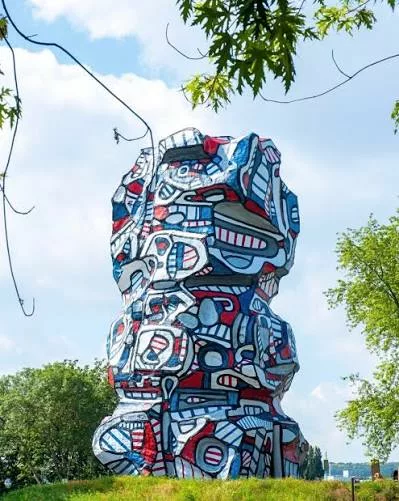
Located in the Île Saint-Germain park, downstream along the Seine, the work is part of the “Hourloupe” cycle, a series of works characterized by red, blue, and white elements and created between 1962 and 1974. “Hourloupe” draws inspiration from other words: “hurler” (to scream), “hululer” (to hoot), “loup” (wolf), and “entourloupe” (trick). Jean Dubuffet traces lines across the paper with a red pen and cuts out his figures by drawing red and blue stripes. Architect Antoine Butor worked closely with Dubuffet on this piece.
The Tower of Figures stands 24 meters tall and is 12 meters wide. Its concrete base structure is reinforced by a secondary metal framework, covered with a skin consisting of 90 resin panels painted with polyurethane. White, blue, red, and black are the colors that adorn the tower; it is unclear whether they represent bodies or faces; black lines delineate the imaginary world envisioned by the artist. The interior, made of black and white plaster, is a labyrinth that unfolds during an 117-meter ascent across five floors, known as “the gastrovolve.” It is a second, interior artwork where visitors ascend, descend, reflect, try to find their bearings, and lose themselves in this unusual journey designed to give free rein to the imagination. It takes several laps to complete the entire route.
The Tour aux Figures was commissioned by the French government and is now designated a historic monument. Completed by the Dubuffet Foundation, it was inaugurated in 1988, three years after the artist’s death. This year, it will be open to visitors through November.
As Jean Dubuffet’s final work, it fits well within the semantic framework the artist favored:
“If professors were handed a surveyor’s chain and compass and asked to stake out the terrain by planting the ‘stake of savagery’ where it belongs, the stake of freedom, and those marking all the other milestones of thought, they would face the same dilemma as when determining the exact point where the stake of art brut should be set ; For art brut, savagery, and freedom must not be conceived of as places—and certainly not as fixed places—but as directions, aspirations, and tendencies.” Jean Dubuffet
Photo credits: Dubuffet Foundation